
The market context most comparisons ignore
Two things changed in Abu Dhabi in 2026 that make the standard advice out of date.
Space is scarce. Abu Dhabi's citywide office vacancy sat at 1.4% in Q2 2026, with prime vacancy at just 0.1%, against a total stock of around 4.18 million square metres. Prime office rents rose 11.7% year on year, with Grade A up 5.1% and Grade B up 4.2%. In a market that tight, "which is cheaper" is often the wrong question, because a suitable conventional unit may simply not be available in the location and size you need.
Rent increases are frozen. On 2 June 2026, ADREC reduced the annual rental increase percentage from 5% to 0% across residential, commercial and industrial properties in the emirate, temporarily and until further notice. Lease renewals and new agreements are to reference the rental value recorded in the property's most recent registered Tawtheeq contract. The measure is not retrospective, and it applies to re-lets as well as renewals.
That second point cuts against the usual pitch for flexible workspace. For a business already holding a registered commercial tenancy, the freeze is meaningful rent protection for as long as it lasts. Anyone telling you flexible space is automatically the cheaper option in Abu Dhabi today is not accounting for it.
How the freeze interacts with serviced office and coworking agreements is worth confirming directly with ADREC, since those are often structured as service packages rather than standard registered tenancies. Do not assume it applies to a workspace membership fee.
The three options, defined properly
Coworking means shared or hot desks in an open environment, usually monthly, with facilities shared across all members. Lowest commitment, lowest cost, least privacy, and generally the weakest position on licensing and visa quota.
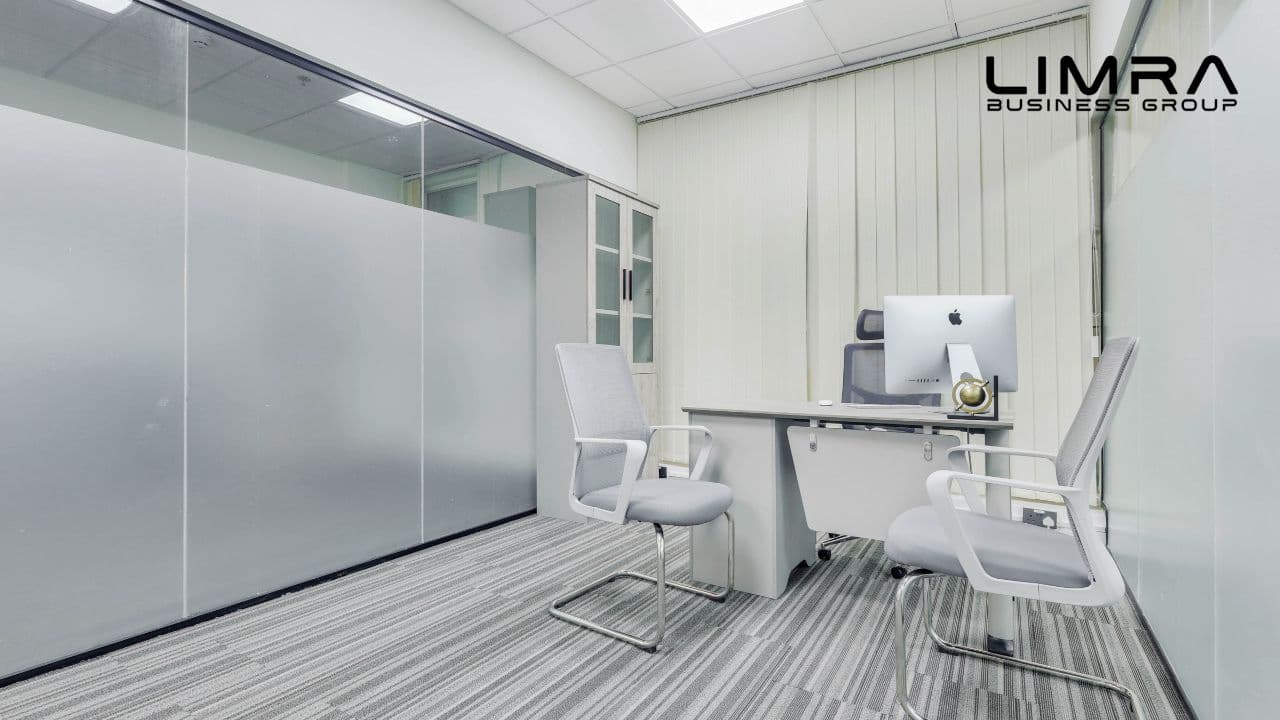
Serviced or managed office means a private, furnished, lockable office inside a managed building, with reception, internet, utilities and meeting room access included in one fee. Higher monthly cost, no fit-out, and typically able to support licensing where the provider is set up for it.
Traditional lease means renting a shell or fitted unit directly, usually annually, with a Tawtheeq-registered tenancy contract in your company's name. Lowest rate per square metre, and every operating cost is yours.
The labels overlap in practice. Judge by what the agreement includes rather than what it is called.
Total cost of occupancy, side by side
| Cost element | Coworking | Serviced office | Traditional lease |
|---|---|---|---|
| Rent or membership fee | Lowest | Middle | Lowest per sq m, highest in total |
| Fit-out and furniture | None | None | Yours, often the largest single outlay |
| Security deposit | Low or none | Commonly 1 to 3 months | Typically a percentage of annual rent |
| Agency commission | None | None | Commonly charged to the tenant |
| Utilities and internet | Included | Usually included | Separate ADDC account and connection |
| Service and maintenance charges | Included | Usually included | Billed separately, ask for historical statements |
| Tenancy registration | Provider handles, if applicable | Provider handles, if applicable | Yours to arrange via the landlord |
| Reception and admin | Included | Included | Your payroll |
| VAT | 5% on commercial rent, recoverable subject to your registration status | Same | Same |
| Time before you can work there | Immediate | Days | Weeks to months |
| Notice to exit | Shortest | Short to medium | Longest, with penalty exposure |
The row that decides most cases is the second to last. A conventional lease that looks 40% cheaper on paper can cost more in year one once fit-out, deposit, commission, connection charges and three months of paying rent on an unusable space are counted.
Where each one genuinely wins
Coworking suits solo founders, remote workers, and businesses testing Abu Dhabi before committing. It is a poor fit if you need to sponsor visas, hold confidential client meetings, or present a fixed address to a bank.
A serviced office suits teams of roughly two to fifteen, businesses that need a licence-compatible address with a real physical presence, and companies whose headcount is uncertain over the next 12 to 24 months. It is the option that most often matches what small and mid-size businesses in Abu Dhabi actually need, which is why the category exists.
A traditional lease suits established teams above roughly fifteen people, businesses with specific fit-out requirements such as clinics, labs, showrooms or workshops, and companies with a stable enough headcount to commit for several years. Regulated activities frequently require it regardless of preference.
Read more: How to Choose a Business Centre in Abu Dhabi: A Practical Checklist
The question that resolves it fastest
Ask what your headcount will be in 24 months, then ask how confident you are in that number.
High confidence and above fifteen people points to a lease. Low confidence at any size points to flexible space, because the cost of being wrong is far higher on a lease than the premium you pay for flexibility. That premium is essentially an insurance payment, and in a market at 1.4% vacancy it is not an expensive one.
Frequently asked questions
1. What is the difference between coworking and a serviced office in Abu Dhabi?
Coworking provides shared or hot desks in an open environment on short terms. A serviced office provides a private, lockable, furnished room within a managed building, with reception, utilities and meeting room access included. Serviced offices cost more and are generally better positioned for licensing and visa purposes.
2. Is coworking cheaper than renting an office in Abu Dhabi?
Per month, usually yes. Over a full year including fit-out, deposits, agency commission, utility connection and the period before a conventional unit is usable, the gap narrows considerably and often reverses for small teams. Compare total cost of occupancy over your actual time horizon.
3. Does the Abu Dhabi rent freeze apply to commercial offices?
ADREC's measure, effective 2 June 2026, covers residential, commercial and industrial properties across the emirate, setting the annual rental increase percentage at 0% temporarily and until further notice. Renewals reference the value in the most recent registered Tawtheeq contract. Some free zone jurisdictions operate under separate frameworks, and application to serviced office packages should be confirmed with ADREC.
4. Which is best for a startup in Abu Dhabi?
For most startups, a serviced office or coworking desk, because headcount is uncertain and capital is better spent elsewhere than on fit-out. The exception is any activity requiring specific premises or regulatory approval, where a conventional space may be necessary from the start.
5. Can I get a trade licence with a coworking desk?
It depends on the licence route, the activity and whether the provider issues a registered tenancy for that space type. Open hot-desk arrangements often do not support licensing. Confirm with the provider and with ADRA before committing.
6. How much notice do I need to leave a serviced office?
This varies by provider and is set by the agreement rather than by regulation. Check the notice period, whether early exit is permitted, what penalty applies and how long deposit refunds take, before signing.
7. What is the biggest hidden cost of a traditional office lease?
Fit-out is usually the largest, followed by the months of rent paid before the space is usable. Deposits, agency commission, service charges, utility connection and 5% VAT on commercial rent also sit outside the headline rate.
How Limra Business Group helps
Limra Business Group manages over 500 properties across Abu Dhabi and operates three business centres in central locations: Nahel Tower in Najda, Muroor in Al Nahyan, and Saif Tower in Electra.
That means we can answer this question without a preferred answer. If a conventional lease genuinely suits you better, we manage that side of the market too and can talk you through what is available. If flexible space fits, we can move you from a desk to a private office as the team grows without changing buildings or restarting your paperwork.
Either way, tenancy documentation, Tawtheeq assistance, trade licence support, PRO and document clearing, and visa guidance sit with one team rather than being split between a workspace operator and an absent landlord.
Call +971 2 447 8660 or book a visit to any of our three Abu Dhabi centres to work through the numbers for your situation.
This article is general information, not legal, tax or real estate advice. Market figures are as reported for Q2 2026 and will change. The rental increase measure described is temporary and subject to revision by ADREC. Licence conditions, premises requirements and quota decisions are set by ADRA, ADDED, MOHRE and Abu Dhabi's municipal and real estate authorities, and vary by activity and legal form. Cost descriptions reflect general market practice and are not quoted terms. Confirm current requirements with the relevant authority before making commitments. Limra Business Group provides property management, workspace and business support services and does not act as a legal advisor.